
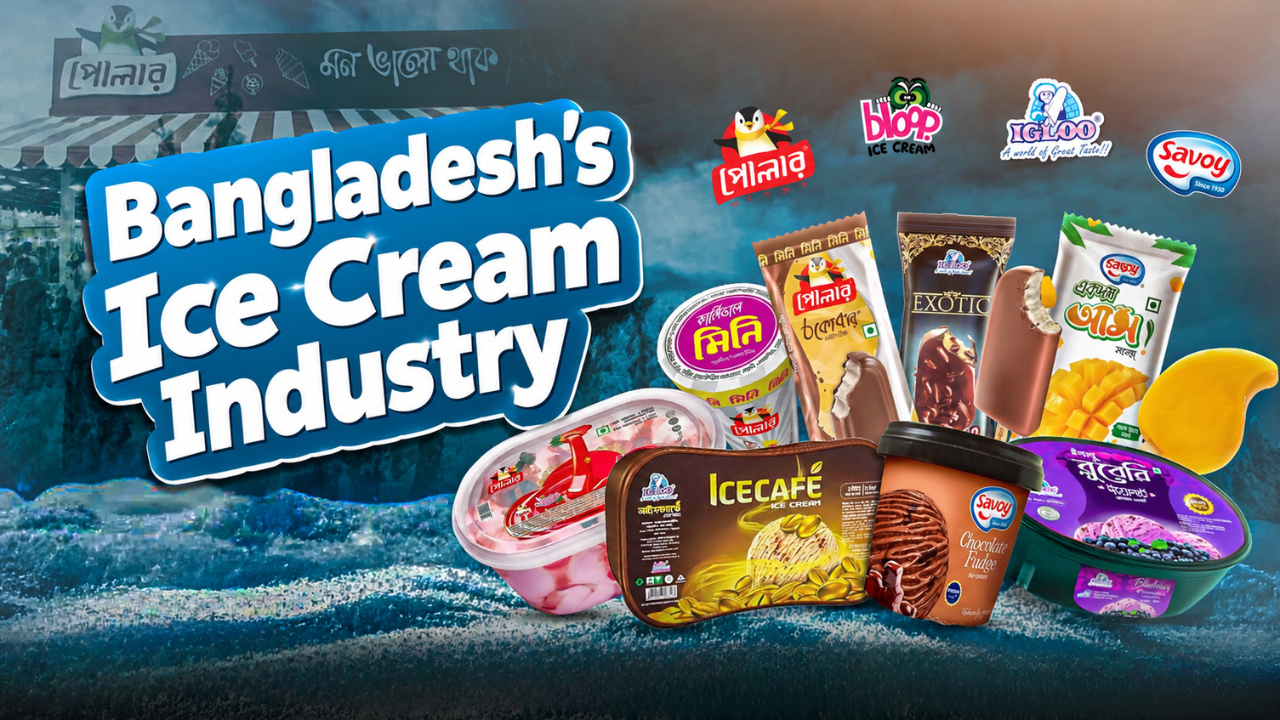
During Bangladesh’s scorching summers, people tend to consume ice cream alongside cold drinks. However, over the past decade, ice cream consumption has increased significantly. The country has an annual demand of 60 million litres of ice cream. In the fiscal year 2025–26, Bangladesh’s ice cream market was estimated to be worth approximately BDT 3500 crore, compared with approximately BDT 1400 crore in 2021, highlighting the rapid growth of Bangladesh’s ice cream industry.
Overview
The history of frozen desserts in the Indian subcontinent dates back to the Mughal era, when kulfi became popular. This is an important part of the region’s frozen dessert history. According to a report published by The Business Standard (TBS) in October 2023, during the Mughal period, kulfi was combined with faluda to create another dessert, which is now widely known as tutti frutti.The production of the type of ice cream we recognize today began in Bangladesh mainly during the 1950s. During that decade, an ice cream factory called Baby Ice Cream Factory was established in Azimpur, Dhaka. Baby Ice Cream was the first organized ice cream business established in this region of Bangladesh, marking the beginning of the country’s ice cream industry. In the late 1950s or early 1960s, Baby Ice Cream opened an ice cream shop in Gulistan. It was the first dedicated ice cream parlor in Dhaka and what was then East Pakistan.
Around 1950, the government of the time acquired the Gulistan area and initiated a redevelopment project. The plan included building cinema halls, markets, and various recreational facilities for Dhaka’s residents. As a result of these developments, Gulistan began to take on a new look by 1954. Baby Ice Cream took advantage of this opportunity and quickly became one of the attractions for people visiting Gulistan for entertainment. Initially, Baby Ice Cream gained considerable popularity across Dhaka because of its attractive packaging and ice creams available in different shapes. Its products were mainly distributed through street vendors in local neighborhoods and near school gates. During the 1960s, another ice cream parlor named Novel became increasingly popular among upper-middle-class families at Dhaka’s New Market. Meanwhile, in 1964, K. Rahman & Co. began producing ice cream on a small scale at its Coca-Cola bottling plant in Chittagong and established an ice cream parlor in Dhaka in the same year. This plant was another important milestone in the development of commercial ice cream production in Bangladesh. After independence in 1971, the company was nationalized. Later, in 1983, Abdul Monem Limited acquired the plant under the government’s privatization policy. After taking over the business, Abdul Monem Limited rebranded it as Igloo, which is now one of the leading players in Bangladesh’s ice cream industry. In fact, since Baby Ice Cream no longer continues production, Igloo is the oldest ice cream brand in Bangladesh that remains operational.

In 1987, the Polar Ice Cream brand was established by Dhaka Ice Cream Industries Limited. Polar brought in experts from Denmark and established its own ice cream production facility in Tejgaon, Dhaka.In 1997, Kwality Ice Cream was launched by the Sanowara Group. After 2000, several more brands entered the market. Among the most popular were Bellissimo and Za’n Zee from Kazi Food Industries, Bloop from Golden Harvest Ice Cream Limited, Lovello, Savoy, and Mi Amore. These brands are now among the key players in the country’s ice cream market.According to a report published by The Daily Sta, Bangladesh has an annual domestic demand of approximately 6 crore liters of ice cream. Most of this demand is served by seven major brands: Igloo, Polar, Kwality, Za’n Zee, Bloop, Lovello, and Savoy.According to a report published by Prothom Alo April 19 2025, Polar leads Bangladesh’s ice cream market with a 31.51% market share. Igloo follows with approximately 27% of the market. Savoy ranks third with around 13.45%, while Lovello holds fourth place with a 11.71% market share.
According to the 2020–21 annual report of Golden Harvest, a publicly listed company that produces ice cream and various food products, Bangladesh’s ice cream market was worth approximately BDT 730 crore in 2020. The following year, in 2021, the market nearly doubled to approximately BDT 1400 crore. A report published by Prothom Alo states that the market was worth approximately BDT 3400 crore in FY2023–24. In FY2025–26, the market was estimated to be worth approximately BDT 3500 crore. In other words, over the past six years, the size of Bangladesh’s ice cream market has increased approximately 4.8 times, representing growth of around 380%.
Current Trends
Introduction of New Flavors
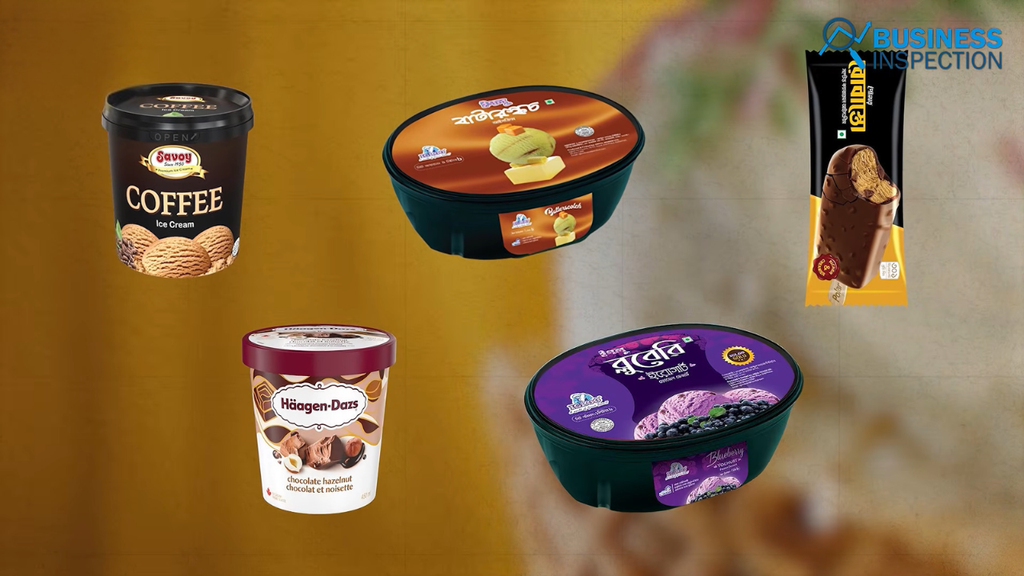
Bangladesh’s ice cream industry has undergone significant changes over time, becoming an important part of the country’s food and beverage sector. In the early days of the industry, ice cream offerings were largely limited to vanilla and chocolate flavors. In the early 2000s, mango and strawberry flavors also gained popularity in the domestic market. In fact, vanilla, chocolate, mango, and strawberry remained among the most popular flavors in Bangladesh’s ice cream industry for a long time. However, since the late 2000s, the industry has gradually introduced ice creams in a wider variety of flavors. Consumer interest in trying different flavors has continued to grow. The country’s two leading ice cream players, Polar and Igloo, have played a major role in introducing new flavors to the market. Initially, these companies began offering familiar local flavors such as malai, kheer, and yogurt in the form of ice cream. Consumers readily embraced these offerings. Kazi Food Industries’ Bellissimo has also played a significant role in introducing internationally popular ice cream flavors to the domestic market. Through these companies, flavors such as coffee, butterscotch, salted caramel, hazelnut, and blueberry yogurt were introduced to consumers. These ice creams are not limited to one-liter or half-liter boxes. They are also available in larger two-liter and five-liter packs. At the same time, they are sold in cups, cones, and bars. Alongside these flavors, fruit-flavored ice lollies have also gained considerable popularity.
Growing Ice Cream Parlours
Ice cream from different brands is widely available at grocery stores and departmental stores across the country, meeting the majority of domestic consumption demand. However, several ice cream parlors have recently become increasingly popular in Bangladesh. A growing trend in the market is the introduction of ice creams featuring flavors developed by individual parlors, primarily targeting young consumers with new and distinctive offerings. According to the website Smartscrapers, as of April 1, 2026, there were 517 ice cream shops in Dhaka. Approximately 98.26% of these shops are independently owned businesses, while only 1.74% belong to the country’s large ice cream brands. The same website also reports that the average age of these ice cream shops ranges from two to seven years. This suggests that the number of small ice cream parlors has been growing rapidly as part of this recent trend.
In fact, the growing preference for new flavors offered by modern ice cream parlors has influenced the launch of several new products in the wider market. Examples include Igloo’s Blueberry Yogurt and Ambrosia, Polar’s Caramel Touch, and Bloop’s English Toffee.
Reasons Behind the Growth
Rise of the Affluent Class and Urbanization
Alongside Bangladesh’s economic growth over the past decade, the size of the country’s middle and affluent classes has increased significantly. The expansion of the working population has contributed to higher incomes, allowing people to increase their overall consumption beyond basic necessities. As disposable incomes have risen, consumer preferences for ready-to-eat and convenient foods have also grown. There was a time when ice cream was considered a seasonal or occasional food, consumed primarily during summer. However, with the growth of the middle and affluent classes, ice cream consumption is no longer limited to special occasions or the summer season. Although sales remain highest during the summer, several factors—including longer summers and shorter winters associated with climate change, along with the increased purchasing power of Bangladesh’s middle class—have helped maintain demand and sales throughout the year. At the same time, the expansion of the middle and affluent classes has been accompanied by rapid urbanization in Bangladesh. Over the past decade, the country has developed the infrastructure needed to expand electricity supply, increased power generation, and improved transportation networks. As a result, facilities and conveniences similar to those available in cities have become more accessible in rural areas. These changes in people’s lifestyles, driven by urbanization, have expanded demand for ice cream beyond cities and into rural communities across the country.
Expansive Distribution Network
The expansion of ice cream companies’ nationwide distribution networks has played a crucial role in the growth of Bangladesh’s ice cream market. This expansion has been made possible in part by improvements in transportation infrastructure over the past decade, including the construction of highways, expressways, bridges, and new roads across the country. In the past, poor transportation links and the need to maintain constant refrigeration during transportation made ice cream distribution a major challenge for companies. Delivering ice cream beyond smaller towns and into rural areas was particularly difficult. However, as the country’s transportation infrastructure has improved and people in smaller towns and rural communities have increasingly adopted modern lifestyles, ice cream companies have expanded and strengthened their distribution networks. They have also invested in modern refrigerated transportation systems. Improvements in cold chain logistics have made it possible to deliver ice cream to every corner of the country while maintaining product quality. Greater access to electricity has also enabled shopkeepers in rural areas to store ice cream. Through these investments in supply chain infrastructure, ice cream has evolved from a predominantly summer product into a popular food consumed throughout the year.
Changing Consumer Preferences
Today’s young consumers are more aware of their options than consumers in previous generations, and they constantly seek to explore new products and experiences.
Furthermore, the growth of Bangladesh’s middle and affluent classes over the past decade has changed consumer behavior. Whereas people previously consumed products primarily out of necessity, many now seek new experiences and greater variety. Keeping pace with these changing preferences, companies have introduced a wide range of new ice cream flavors to the Bangladeshi market. Over the past decade, domestic ice cream companies have introduced flavors such as coffee, butterscotch, salted caramel, hazelnut, and blueberry yogurt. The market has also seen the introduction of waffle cones, mochi ice cream, and ice cream sandwiches. To keep up with changing consumer tastes, companies try to introduce several new ice cream flavors every year. This has become a positive growth factor for Bangladesh’s overall ice cream industry.

Challenges
The biggest challenge facing Bangladesh’s ice cream market is maintaining competition while ensuring that consumers receive good-quality products. For a long time, Igloo, Polar, and Kwality were the three major players controlling the country’s ice cream market. However, the number of ice cream brands in Bangladesh has increased significantly over the past decade, intensifying competition. Yet, because Bangladesh does not have a consistent regulatory framework for food products, questions remain about overall product quality. Another challenge is the industry’s dependence on imported raw materials. Since most of the raw materials required for ice cream production must be imported, fluctuations in the US dollar exchange rate increase production costs. This makes it difficult for companies to maintain stable profit margins. Cold chain management is another major challenge for the industry. Although access to electricity has expanded across the country, a continuous and uninterrupted power supply has yet to be ensured. As a result, load-shedding remains a regular problem. Meanwhile, the current dollar shortage and energy crisis create additional difficulties for the industry. If Bangladesh can improve its cold chain logistics infrastructure despite these challenges, the ice cream sector could become even more promising in the years ahead.






Leave a Comment