
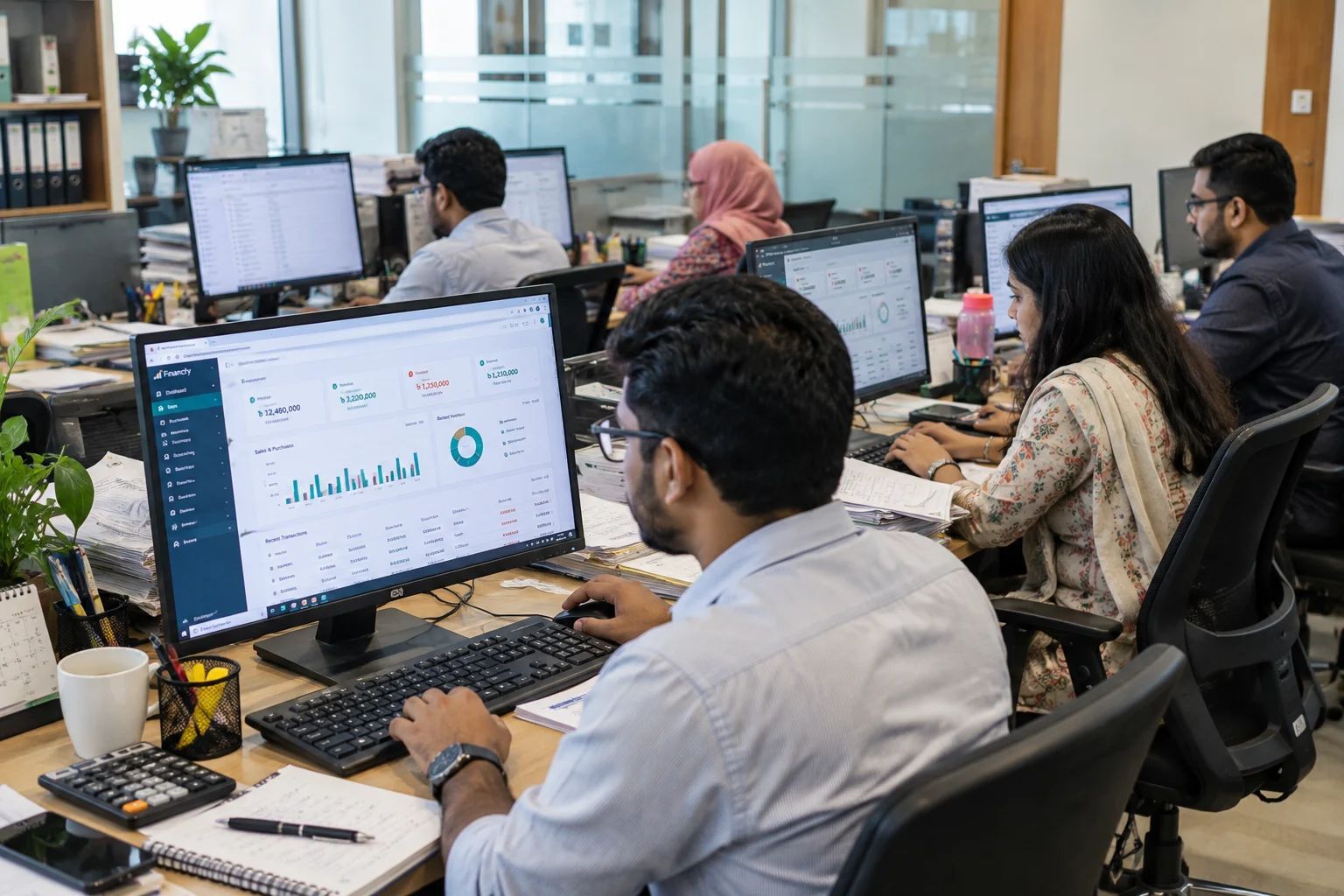
For years, accounting in Bangladesh meant notebooks, ledgers, calculators, and eventually Excel spreadsheets. Businesses often kept sales, expenses, and inventory in separate files, while monthly accounts depended on manually matching everything. This familiar process became increasingly difficult as businesses grew, with more transactions, calculations, files, and chances of data mismatch. This is where accounting software is becoming an increasingly important part of everyday business operations.
This growing shift is particularly visible among SMEs and mid-sized businesses that have outgrown spreadsheets and need a more structured solution, but do not yet require the cost and complexity of enterprise-level ERP systems. For SMEs looking for the best accounting software in Bangladesh, affordability, ease of use, and support for local business practices are important considerations. Financfy addresses these needs through a cloud-based platform that brings accounting, sales, purchasing, inventory, and business analytics into one system.
Before such systems, businesses could manage daily expenses through manual ledgers and Excel, prepare financial information separately, reconcile costs at month-end, and spend additional time checking whether numbers matched. Reports could take days to prepare, while formula errors and data mismatches could affect accuracy. As a result, management often made decisions based on previous-month information rather than knowing what was happening in the business in real time.
Financfy brings these activities into one continuously updated database. Businesses can manage Financial Accounting, Sales Management, Purchase Management, Inventory Management, Accounts Receivable and Payable, Cash and Bank Management, and Financial Statements through the same platform. More than 100 business and accounting reports can also be generated in real time, replacing many of the reports that previously had to be prepared manually in Excel.

Its cloud-based system also means financial information is accessible from anywhere. An owner in Dhaka can check the company’s numbers while travelling to Chattogram, giving owners and managers greater visibility into sales, expenses, inventory, and financial performance. The Management Dashboard further brings key business information into one place, allowing owners to monitor operations regularly instead of checking financial records only at month-end. This moves accounting software beyond transaction recording and into everyday business management.
Financfy is designed for trading and distribution, manufacturing, import and export, retail and wholesale, service-based businesses, and corporate SMEs requiring multi-user, role-based accounting.
The need for this type of platform comes from a clear gap in the SME market. Manual bookkeeping and Excel are inexpensive and familiar but can become slow and error-prone as transaction volumes increase. Traditional ERP systems, meanwhile, can be expensive, complex, and difficult for lean businesses with limited staff and IT budgets to adopt. Financfy aims to fill this gap through enterprise capability with SME simplicity and subscription pricing.
Operating on a SaaS subscription model, Financfy allows businesses to start with a monthly subscription instead of making a large upfront ERP-style investment. Packages can scale with business size, making business automation more accessible without requiring long-term software commitments or large IT infrastructure.
Since launching in 2023, Financfy has onboarded more than 100 businesses across Bangladesh, including QA Harbor, Nymph Solutions, Farmiaan Dairy & Consumer Food Products Co., Agrilife Ltd, Sal-Sabeel Cars, and Newaz Steel Limited. Customer acquisition comes through direct sales, channel partners, cold calling, referrals, and digital acquisition, giving the company multiple routes for bringing businesses onto the platform.
QA Harbor provides an example of the transition from manual accounting to software-based financial management. Before adopting Financfy, the company managed daily expenses through manual ledgers and Excel, while monthly cost reconciliation was difficult and time-consuming. Frequent data mismatches added to the challenge. After adopting Financfy, the Managing Director began primarily using the mobile app for daily financial oversight. The company estimates that financial tracking time has fallen by around 80–90%, while the system also helped identify unnecessary expenses and previously unnoticed cost patterns. On QA Harbor’s experience with Financfy, Kazi Safaet Mahmud Auvi, Co-Founder & CEO, said, “Easy UI with a knowledgeable team to assist.”
The broader change is not simply replacing a notebook or Excel file with an application. It is a shift in how businesses use financial information. Manual accounting often shows what happened after the fact, while an integrated platform provides a more current view of sales, purchases, inventory, cash, and expenses. This can help management identify unnecessary costs, monitor cash flow, understand performance, and respond to changing business conditions more quickly.
Financfy also focuses on local requirements rather than simply adapting a foreign software model. The platform is designed around Bangladeshi tax, compliance, and business practices, with local support in Bangla and English. This matters because successful software adoption depends not only on features but also on whether employees can understand and use the system without months of complicated implementation.
The transformation from manual accounting and traditional offline accounting software to cloud-based accounting solutions is therefore becoming less about accounting alone and more about providing businesses with real-time visibility, accessibility, and better control over their financial operations. As Bangladeshi SMEs grow, financial records are no longer simply something to store; they are becoming a source of real-time business information. For companies moving beyond scattered ledgers and Excel spreadsheets, accounting software is creating a connected way to manage the wider business and gain the visibility and control of a much larger organization.







Leave a Comment