
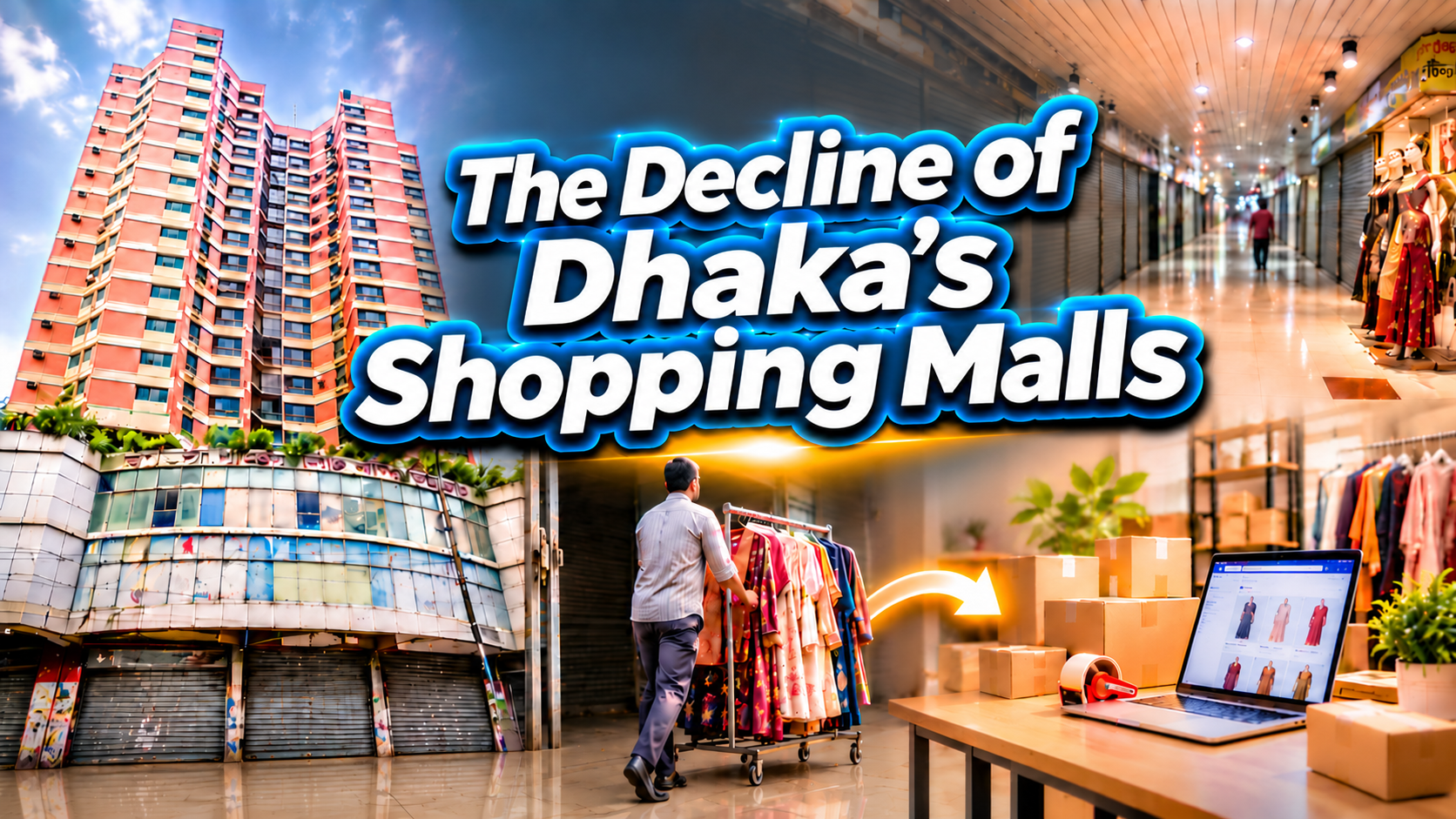
Once, Dhaka’s popular shopping malls remained crowded with customers throughout much of the year, especially during major festivals such as Eid, Durga Puja, and Pohela Boishakh. Beyond shopping for clothes, shoes, and cosmetics, these malls were also popular destinations for families to spend time together and enjoy leisure activities. However, that situation has changed considerably over time. Shops are closing due to declining customer traffic, while many business owners are changing their business models. Recently, the once-popular Karnaphuli Garden City Shopping Complex permanently closed its doors. And it is not the only shopping center facing difficulties. Several other well-known markets in Dhaka are also experiencing serious business challenges.
Overview
Local markets were once the primary shopping destinations for people across Bangladesh. However, in 1953, Dhaka New Market was established as the city’s first planned shopping center. Following this development, the Dhaka City Corporation introduced several additional shopping centers, which gradually became popular destinations for residents of the capital. However, as Dhaka’s middle and affluent classes continued to expand, consumer shopping preferences also began changing. By the late 1980s, demand for more modern and organized shopping malls had become increasingly evident. In response, Eastern Plaza opened in 1988, introducing Dhaka’s consumers to a fully air-conditioned shopping environment for the first time. From the 1990s onward, multistory shopping malls gradually began appearing across the capital’s commercial areas. These shopping centers allowed customers to purchase clothing, footwear, cosmetics, jewelry, and various other essential products under one roof. At the same time, facilities such as air conditioning, escalators, elevators, and parking spaces made modern shopping malls increasingly attractive to consumers. This expansion continued in 2004 with the opening of Bashundhara City Shopping Complex in Panthapath, further accelerating the development of Dhaka’s shopping mall culture.
During this period, the expansion of shopping malls also created new business opportunities. Many retailers moved their businesses from traditional markets into modern shopping centers, while numerous new entrepreneurs found opportunities to establish their own stores. Some business owners even began opening outlets across multiple shopping malls. Over time, these shopping centers developed into complete business ecosystems, supporting a wide range of retailers and related commercial activities.
However, this situation has changed significantly in recent years. The expansion of large modern shopping malls, branded showrooms, and online shopping platforms has provided consumers with more purchasing options than ever before. Meanwhile, customer traffic at several once-popular shopping malls has steadily declined. As foot traffic has fallen in older shopping centers, many retailers have begun relocating their businesses to more promising locations. One of the most prominent examples is Karnaphuli Garden City Shopping Complex. Established in 1998 by Karnaphuli Group, the 20-story building was located at the Shantinagar-Kakrail intersection in Dhaka. Its lower floors housed a shopping mall, while the upper floors contained residential apartments. With approximately 198 shops, a food court, and other facilities, the complex became a popular destination not only for shopping but also for leisure activities. However, its commercial performance gradually began to deteriorate. According to reports, the difficulties intensified around 2016–17, when construction of the Shantinagar Flyover disrupted access to the shopping center. The situation worsened during the COVID-19 pandemic, prompting many established retailers to relocate. Even after the flyover opened and the pandemic ended, these businesses did not return. Consequently, the remaining shops experienced increasing financial pressure, encouraging more retailers to move elsewhere. Eventually, only around 20 to 25 of the complex’s original 198 shops remained operational. With fewer customers and declining rental and service charge collections, meeting electricity bills and other operating expenses became increasingly difficult. Finally, the main shopping complex at Karnaphuli Garden City officially closed on October 1, 2026.

However, this crisis is not limited to Karnaphuli Garden City. According to The Daily Star, at least 10 other older shopping complexes in Dhaka are also facing the risk of closure due to declining customer numbers and prolonged business difficulties. But why have the business models of these once-profitable shopping malls become so vulnerable?
The Decline of Dhaka’s Shopping Malls
Several economic and commercial factors are contributing simultaneously to declining customer traffic and worsening business conditions across Dhaka’s older shopping malls.
The Cost of Living Crisis
One of the most significant factors is the declining purchasing power of consumers. The commercial success of a shopping mall largely depends on how much money people can spend on shopping after covering their essential living expenses. According to the Bangladesh Bureau of Statistics (BBS), the country’s overall inflation rate reached 8.34% in September 2026, while food inflation stood at 7.22% and non-food inflation reached 9.30%. Meanwhile, in August 2026, the overall inflation rate was 8.26%, compared with a wage growth rate of only 8.05%. In other words, the prices of goods and services have been increasing faster than average wages in Bangladesh.
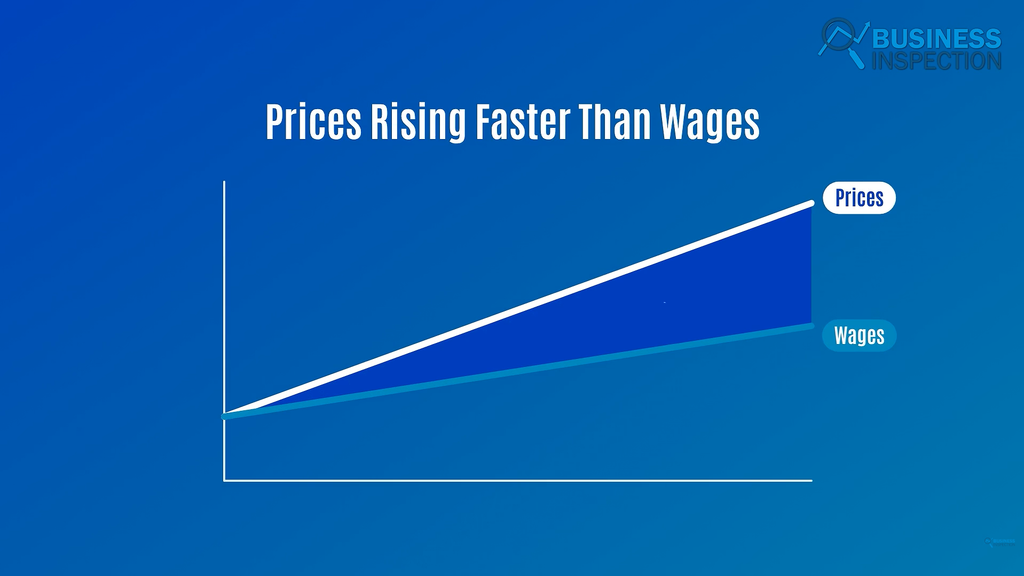
Consequently, after paying for essential household expenses such as rent, food, healthcare, education, and transportation, families have less disposable income available for clothing, footwear, and other lifestyle products. This decline in purchasing power is also affecting the country’s fashion retail industry. According to a report published by The Daily Star in May 2026, fashion and footwear retailers in Bangladesh failed to achieve nearly 60% of their expected sales during the Eid al-Adha shopping season. This indicates that weaker consumer spending is affecting the broader retail market, not just older shopping malls. However, alongside spending less, consumers are also changing where they prefer to shop.
The Rise of Online Shopping
One of the most significant transformations in Bangladesh’s retail industry over the past decade has been the rapid expansion of online shopping. Previously, consumers had to visit physical markets to purchase clothing, shoes, or cosmetics. Today, however, they can order these products from home through social media pages, e-commerce websites, and online sellers. According to data reported by the Bangladesh Sangbad Sangstha (BSS), approximately 14.4% of internet users in Bangladesh have made purchases online, while the figure reaches 21.3% in Dhaka Division. More importantly, among individuals who have shopped online, approximately 70.3% purchased clothing, footwear, or sporting goods. Meanwhile, 17.9% purchased cosmetics, and 8.7% purchased electronic products. These figures indicate that traditional shopping malls are now competing directly with online retailers across some of their most important product categories. One of the biggest advantages of online businesses is that many sellers do not need to rent expensive retail spaces inside shopping malls. As a result, they can operate with comparatively lower overhead costs and often offer products at competitive prices. However, the same survey found that approximately 75.8% of individuals who had not purchased products or services online preferred shopping in person so they could physically examine or touch the products. This suggests that demand for physical shopping still exists. Therefore, the decline of Dhaka’s older shopping malls cannot be attributed solely to the growth of online shopping.
The Changing Retail Competition
Alongside online sellers, Dhaka’s older shopping malls are facing increasing competition from modern shopping centers, branded retail outlets, and lower-priced street markets. For many consumers today, shopping is no longer just about purchasing a product. The overall shopping environment, parking facilities, food courts, and product variety also influence their purchasing decisions. Meanwhile, price-sensitive consumers increasingly prefer shopping at destinations such as New Market, Gausia, and roadside markets. This shift is partly driven by declining purchasing power among middle-income households, which encourages consumers to reduce their shopping expenses. At the same time, the availability of comparatively better-quality products in street markets has made these alternatives more attractive. Consequently, middle-class consumers can often purchase products of similar quality at lower prices. This leaves older shopping malls competing on two fronts: against low-cost traditional and street markets on one side and modern malls offering better shopping experiences on the other. When these older shopping centers also lose established brands, attractive product collections, or customer confidence, their competitive positions become even weaker.
The Cost Behind an Empty Shopping Mall
However, the operating expenses of a shopping mall do not automatically decline when customer traffic decreases. Shopping mall businesses generally depend on a cost structure dominated by fixed operating expenses. Regardless of how many customers visit their stores, retailers must continue paying rent, service charges, employee salaries, electricity bills, and other recurring expenses. According to Dhaka Tribune, Karnaphuli Garden City’s monthly operating expenses exceeded BDT 15 lakh before its closure. However, the remaining shops generated only around BDT 1 lakh to BDT 1.5 lakh in monthly service charge collections, creating a monthly shortfall of at least BDT 13.5 lakh. At the same time, outstanding electricity bills had reportedly accumulated to approximately BDT 50 lakh.

The Impact of Shorter Business Hours
Another challenge facing shopping malls and other retail businesses in Bangladesh has been the government’s restrictions on business operating hours. In August 2026, as part of electricity conservation measures, the government instructed shopping malls and retail stores to close by 8:00 PM instead of 10:00 PM. According to a report published by The Daily Star in September 2026, retailers reported that sales at shopping malls declined by approximately 20% to 30% following the implementation of the new closing hours. One of the main reasons is that a significant portion of employed consumers typically visit shopping malls during the evening after finishing work. With stores closing earlier, these customers now have less time to shop for necessary products after office hours. As a result, some consumers have shifted toward ordering products online, while others purchase items from roadside vendors on their way home. For retailers already operating with narrow profit margins, these additional pressures have made maintaining business operations even more challenging.
However, it is important to recognize that not all older shopping malls in Dhaka are experiencing the same situation. For example, although business activity at Concord Twin Tower has weakened, its management has stated that no decision has been made to close the market. Similarly, while Bishal Centre in Moghbazar and Molla Tower in Rampura are facing commercial difficulties, these shopping centers are not shutting down. Meanwhile, many retailers are adapting to changing consumer behavior by operating through both online and offline channels, allowing them to reach customers beyond their physical stores.






Leave a Comment